
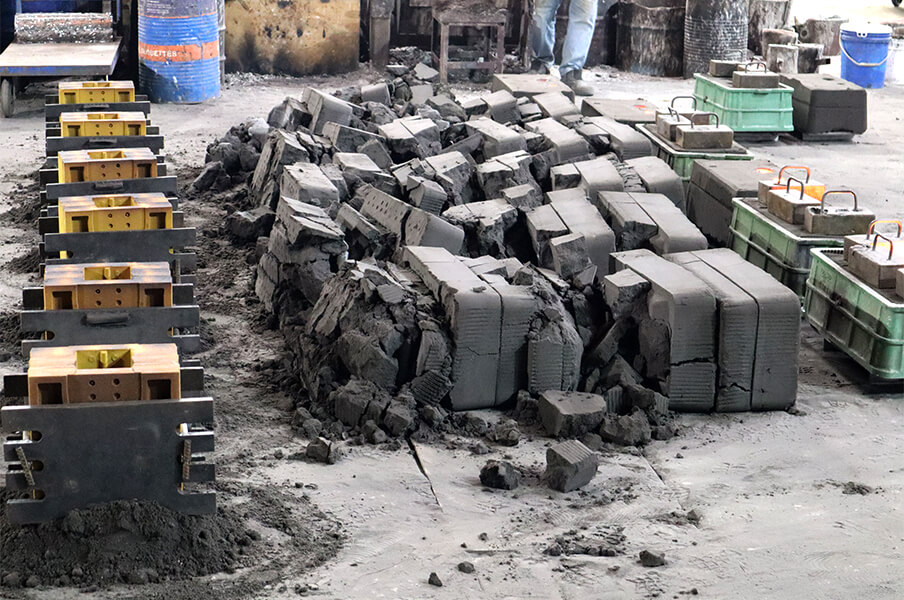
sand casting service、sand casting foundry
sand casting servicesand casting foundry Also known as a casting method that uses silica sand as the molding material; sand casting serviceit is suitable for casting various metal materials. Its advantages are low cost, reusable molds, and the ability to produce castings with varying thicknesses and complex shapes. The manufacturing process is as follows:
- Mold making
- Sand molding molds
- Mould casting
- Cleaning of castings
- Post-machining of castings (removing casting spatter, grinding and polishing)
- Cast parts size and appearance inspection
Cast alloy materials
High Chromium Cast Iron
Wear-resistant materials with excellent wear resistance and appropriate toughness and corrosion resistance. Widely used in industrial equipment components such as steel metallurgy, power, mining, cement, crushing machines, and sand pumping pumps.
Heat-resistant steel
High alloy cast steel materials with excellent heat resistance (~1,200°C) and high temperature strength, high temperature oxidation resistance, and corrosion resistance are widely used in equipment components such as steel, petrochemical, cement, heat treatment, automobiles (exhaust manifold turbine booster casing), and incinerators.
Stainless steel
An alloy material with excellent corrosion resistance, temperature resistance (~650℃), and antioxidant properties. It is commonly used in food processing equipment and in components for chemical, pharmaceutical, and (marine) water treatment equipment.
High manganese steel
It combines high impact resistance, wear resistance, and toughness, and is a high-alloy cast steel with no magnetism. It is widely used in steel, cement, crushing equipment (for mining and automotive applications), rail tracks and their transponders, excavators (bucket teeth and ring bands), and sandblasting equipment.
Carbon steel and low alloy steel
With excellent casting and machining properties, it can meet various environmental, temperature, and performance requirements, and can be further strengthened through heat treatment to enhance material performance. It is widely used in equipment and its components in various industries.
Nickel resists cast iron (Ni-resist)
It can be divided into two types: the plate-type and the ball-type. It boasts excellent corrosion resistance, heat resistance, and dimensional stability, and also possesses the properties of cast iron. It is widely used in seawater pump and impeller, electric power generation wind turbine casings, wear-resistant rings for automobiles, and other equipment components such as automotive exhaust manifold turbocharger casings.
Gray cast iron (Ni-resist)
It is a cast iron material with a columnar graphite structure, featuring excellent casting properties, seismic resistance, thermal conductivity, and machinability. It is commonly used to manufacture machine base seats and components for various types of machining operations, automobiles (engine cylinder blocks and brake discs), and other parts.
Cast iron
Also known as ductile cast iron, it is a cast iron material with spherical graphite. It has good ductility, high strength, and machinability. It is commonly used for flat-bottomed pots and pans, water pipes and fitting, various manhole covers and bases, check valves, automobiles (connecting rod shafts, braking caliper brake pump), oil-pressure cylinders and oil-pressure bodies, and sheet metal stamping molds.
Low-expansion cast iron
具有極低的熱膨脹係數( <4.5×10⁻⁶/℃ , ~100℃),以及無磁性,可應用於真空幫浦轉子、晶圓研磨盤、放電加工機下伸臂、半導體曝光設備用定盤、超精密研磨機機台、精密碳纖/玻纖成型用模具等精密設備及零組件。
sand casting serviceProcess
Part design
Based on the requirements and specifications of the parts, design and draw up the drawings for the parts.
Cast-in system design
根據零件的形狀和鑄造要求,設計鑄注系統,包括鑄道、飛邊和浇口。鑄注系統的設計應能使熔融金屬順利注入模型並充填整個型腔。
Mould preparation
根據零件的形狀和尺寸,製備砂模具。通常使用特殊的鑄造砂料(如矽砂)和粘結劑混合而成的砂型。模具可以是單個模具或分為上下兩個模具。
Molding
將砂模料放置在模具中,並使用模具壓實工具塑造砂模的內部和外部形狀。塑模過程中要確保砂模的密實度和形狀準確。
Molding operations
將金屬材料(如熔化的鑄鐵)倒入模具的浇口,讓熔融金屬充填整個砂模型腔。待金屬冷卻凝固後,得到成型的零件。
Mold disassembly
等待金屬冷卻至足夠固化後,拆卸模具以取出成品零件。拆卸模具時要小心以避免損壞零件。
Forging processing
取出的鑄件可能需要進一步的後處理,如去除飛邊、砂殼和砂芯,進行切割、修整、研磨、熱處理等操作,以獲得最終的精度和表面處理。
Inspection and Quality Control
對鑄件進行檢驗,包括尺寸測量、材料檢測和表面質量檢查等。確保鑄件符合規格和品質要求。
Final product
經過檢驗合格的鑄件可以用於組裝成最終的零配件。